[Page 13] COMMANDER’S OFFICE SAN FRANCISCO NAVAL SHIPYARD SAN FRANCISCO CALIFORNIA 11 September 1946
NAVAL SHIPYARD NOTICE No, 244-46
Sub: Vessels Arriving from Bikini – Instructions Governing Special Tests. 1. The following instructions will govern relative to the special teats to be conducted by the San Francisco Naval Shipyard on ships employed in the Bikini operation: A. Planning
1. Procure funds and originate Job Orders. 2. Follow up work procedures developed, smoothing same out, and put into such form as may be promulgated to other activities. 3. Compile all data necessary for the development of such reports as may be required from time to time.
B. Production
1. Develop work procedures in accordance with existing and subsequent instructions.2. See to it that ships have radiological, clearance when they enter yard.
C. Industrial Relations 1. In consultation With Production, disseminate instructions relative to safety precautions.
J. W. FOWLER Commodore, USN Commander
DJBT: CO, OH, OF, CF
SECRET
Page 13 [Page 14 posted]
REPORT NO. 2 EXPERIMENTAL WORK, SAN FRANCISCO NAVAL SHIPYARD SAN FRANCISCO, CALIF.
Spreading 10,000 rads of radiation onto the ground, roofs and lawns and how they cleaned it up. Note that the exposure to the personnel is only for the theoretical amount that future people would be exposed to while in this case, they were using lawn spreaders to put down 1000 and 10,000 rads of radiation. They also thought that these people were standing on clean ground, extending the brushes onto the contaminated ground. What happened to the people depicted in these photographs?
The San Francisco Chronicle Site consists of an 80,000 square feet newspaper printing plant with a surrounding asphalt parking area. The Site occupies a 6.25 acre property located at 1901 Cesar Chavez Street (formerly Army Street) in San Francisco. It was occupied in the 1930s by the American Smelting and Refining Company under the Federated Metals Corporation name, Federated-Fry Metals Plant. The facility was used for brass ingot and lead production; materials used included brass and bronze scrap metals, oxide of tin and lead, and pure forms of these materials. Oxides formed during the melting process were taken off in the form of slags and were either recycled or hauled offsite. The property was acquired by the San Francisco Newspaper Agency in 1987. The existing structures on site were demolished and a new printing plant and a surrounding parking area were built at the site. Continue reading “SAN FRANCISCO NEWSPAPER AGENCY (38330104)”→
This article will be added onto as I post the supporting links. It is a huge story explaining how they spread radioactive contaminant how they mixed it using radioactive materials to create a situation where the radiation levels were at 10,000 rads per hour to simulate the effect of one hour after a nuclear blast.
Film of the Navy purposely contaminating San Francisco with Serratia marcescens in 1951 and in color, “Naval Concepts of Chemical and Biological Warfare” Naval Concepts of Chemical and Biological Warfare (1952), Department of Defense Film Production, National Archives and Records Administration Catalogue # 428.MN.9170A, Declassified NND Authority # 64044
Navy Reports that indicate the Biological Warfare training was concurrent with the Radiological Warfare Decontamination Training at Treasure Island. This constant testing caused an incident in 1950 whereby 11 people were infected by a bacterium that produced a pneumonia that cost a man his life. Senator Edward Kennedy was very upset about this in a 1977 hearing and chewed out the Army official who told the committee about the problem.
A1.05 Simulant Agents Simulant BW agents are microorganisms or compounds having little or no pathogenicity or toxicity, but otherwise resembling true BW agents in certain characteristics or properties, such as viability, size, food or cultural requirements, growth characteristics, persistency, and routes of invasion. They are particularly useful in field testing the behavior of munitions, determination of effect of particle size on penetration of the air passages of animals, survival of vegetable and spore-bearing organisms under experimental and environmental conditions, testing of protective devices and procedures, and for training. purposes. Examples of microbial simulants are serratia marcescens or Bacillus prodigiosus, a vegetable nonsporulating organism, and Bacillus globigii, a spore-forming rod-shaped bacterium. Continue reading “1953-Biological Warfare Training Manual at Treasure Island, San Francisco CA”→
Chemical Warfare Defense Civil Engineer Corps, United States Navy Tp-PL-3 Bureau of Yards and Docks, Department of the Navy Washington, D. C. 1 January 1952 p. 12
133.02 Training Courses A three-week chemical warfare course is conducted at the Chemical Corps School, Fort McClellan, Alabama, (formerly located at the Chemical Center, Maryland) and at the U.S. Damage Control Training Center, Treasure Island, California. Details on courses are given in NavPers 15795 List of Naval Schools and Courses. These courses are designed for key personnel of the defense organization to prepare them to conduct necessary training of station personnel. A proposed course for personnel to be assigned to decontamination operations is outlined in Department of the Army Field Manual FM 21-40, “Defense Against Chemical Attack”
The Navy built a mockup of a ship at Treasure Island which was used to train military personnel how to clean up after a Chemical and/or biological strike. The ship was later built to contain laboratories and a large shower room for decontaminating the personnel exposed to the biological and Chemical agents in the testing.
All Hands The Bureau of Naval Personnel Information Bulletin July 1957 Nav-Pers-O Number 486 The Good Ship ‘Pandemonium’ p. 16 ,Treasure Island,All Hands The Bureau of Naval Personnel Information Bulletin July 1957 Nav-Pers-O Number 486 The Good Ship ‘Pandemonium’ p. 176 ,Treasure Island,
All Hands The Bureau of Naval Personnel Information Bulletin July 1957 Nav-Pers-O Number 486 The Good Ship ‘Pandemonium’ pp 16., Treasure Island,
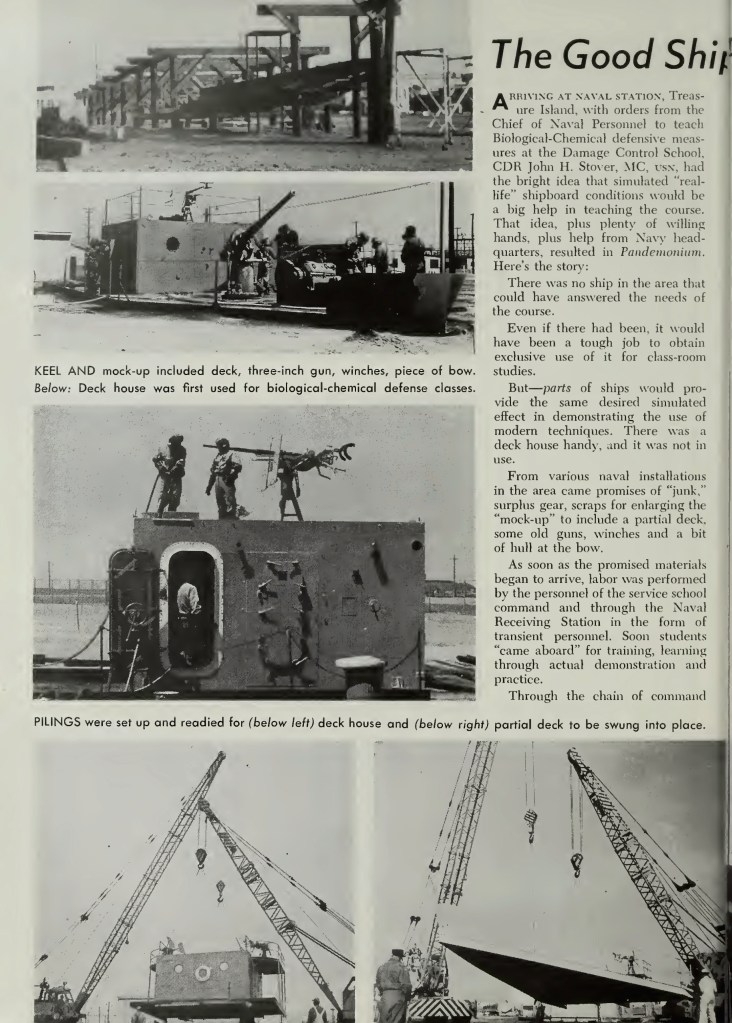
ARRIVING AT NAVAL STATION, Treasure Island, with orders from the Chief of Naval Personnel to teach Biological-Chemical defensive measures at the Damage Control School, CDR John H. Stover, MC, usn, had the bright idea that simulated “reallife” shipboard conditions would be a big help in teaching the course.
That idea, plus plenty of willing hands, plus help from Navy headquarters, resulted in Pandemonium.
Here’s the story:
There was no ship in the area that could have answered the needs of the course.
Even if there had been, it would have been a tough job to obtain exclusive use of it for class-room studies.
But—parts of ships would provide the same desired simulated effect in demonstrating the use of modem techniques. There was a deck house handy, and it was not in use.
From various naval installations in the area came promises of “junk,” surplus gear, scraps for enlarging the “mock-up” to include a partial deck, some old guns, winches and a bit of hull at the bow.
As soon as the promised materials began to arrive, labor was performed by the personnel of the service school command and through the Naval Receiving Station in the form of transient personnel. Soon students “came aboard” for training, learning through actual demonstration and practice.
Through the chain of command application was made to the Bureau of Ships for funds to sink pilings and raise the deck to the level of an actual PC-type vessel for better simulated working conditions. BuShips, realizing the value of such a project, made the funds available. Later, pilings were sunk and the deck house and partial deck were hoisted into place upon them.
This odd-looking vessel with only deck house and partial deck, looked somehow like a house on stilts, with no underpinning.
But now more scraps began to arrive, metal pieces, hatches, and fittings. Plans and photographs of a PC-type vessel were procured, and construction continued.
Fifteen months later, in February, 1957, the “ship” had progressed to an undreamed-of stage. She now measured 173 feet in length, 24 feet at the beam.
BuShips provided money for steel, a wash-down system and utilities and had given cooperation in procuring the many miscellaneous items of equipment.
Bureau of Medicine and Surgery gave financial aid and equipment for shipboard laboratories. BuPers provided funds for shore connections to run the utilities to the ship, and aided by procuring items of equipment including surplus guns, compasses, electrical gear, flags, sextants, and binoculars. A “ship” was taking shape.
On 1 Feb 1957, ceremonies for christening the strange craft were held at the Atomic-Biological-Chemical Defense section of the Naval Schools Command at Treasure Island. The name Pandemonium had been decided upon, since it best described the little ship’s decks immediately following a simulated attack by enemy forces.
At the ceremony, the Twelfth Naval District Band struck up the National Anthem, the Jack was hoisted, and uss Pandemonium (PCDC-1) swept down the ways Here, thanks to a bright idea, students will sail through many years of classroom studies learning defensive measures againt biological and chemical attack.
Medical News Letter, Vol. 26, No. 5 p. 24 Friday, September 20, 1957
Information for Medical Officers Medical officers are encouraged to attend one of the following courses of instruction in the indoctrination of the defensive aspects of atomic, biological, and chemical warfare. Each course is five weeks in duration.
Two weeks are devoted to atomic warfare defense; two weeks to biological chemical warfare defense; and the fifth week to the planning and damage control aspects of special weapons handling. Secret clearance is required for all or any phase of the courses, and prospective students should familiarize themselves with the contents of OpNav Instruction 5510. 1A. Additional information on the courses may be found in BuPers Instruction 1500. 25 and BuPers Notice 1500 of 10 May 1955. Requests for attendance should be processed m accordance with local instructions. Convening dates for the remainder of Fiscal Year 1956 are contained in the directives above. Continue reading “Atomic, Biological and Chemical Training at Treasure Island California 1957”→
United States Navy Medical News Letter, Vol. 30 Friday, September 20, 1957 No. 6 p.29
The U S Naval Radiological Defense Laboratory, San Francisco Naval Shipyard (Hunters Point), will conduct a seminar during the 3-day period, 17 – 19 October 1957, under the sponsorship of the Commandant, Twelfth Naval District. Speakers and discussants scheduled to present the program include prominent military and civilian physicians and scientists.
The Chief of Naval Personnel has authorized the awarding of one (1) retirement point credit to eligible inactive Naval Reserve Medical Department officers for daily attendance, provided they register such attendance with the authorized military representative present. Security clearance is not required.
Additional information concerning this program may be obtained by writing to the District Medical Officer, Twelfth Naval District, 50 Fell St., San Francisco, Calif.
Medical News Letter, Vol. 33, No. 12 op. 20 Training in ABC Warfare for Medical Officers -A Four Weeks’ Course
Course #5 convening 4 January 1960 Location: U.S. Naval Schools Command, Naval Station, Treasure Island, San Francisco, Calif. Student Clearance Required: SECRET Reporting Time and Place: Prior to 2200, 3 January 1960, Personnel Office, U.S. Naval Schools Command, Bldg. 28
Course Objectives
The course is designed for experienced active duty Naval Medical officers possessing SECRET security clearance. It will stress the medical aspects of modern warfare and of military peace time operations, including problems incident to atomic, biological, and chemical weapons systems, nuclear propulsion, mass casualties, and isotope programs. Military aspects of the weapons systems and military countermeasures will also be considered so that Medical officers may function effectively on a staff and can reasonably assess the medical compromises imposed by the military situation. Outstanding speakers, both military and civilian, will be on the program. The course will include visits to the Naval Radiological Defense Laboratory and the Naval Biological Laboratory; it will also include several practical exercises and drills. Texts will be provided for permanent retention Continue reading “Treasure Island Atomic, Biological, and Chemical Warfare for Medical Officers”→



 Disaster Area
You must be logged in to post a comment.