13577 Radiation Film Badges were used at Hunters Point Shipyard in 1960

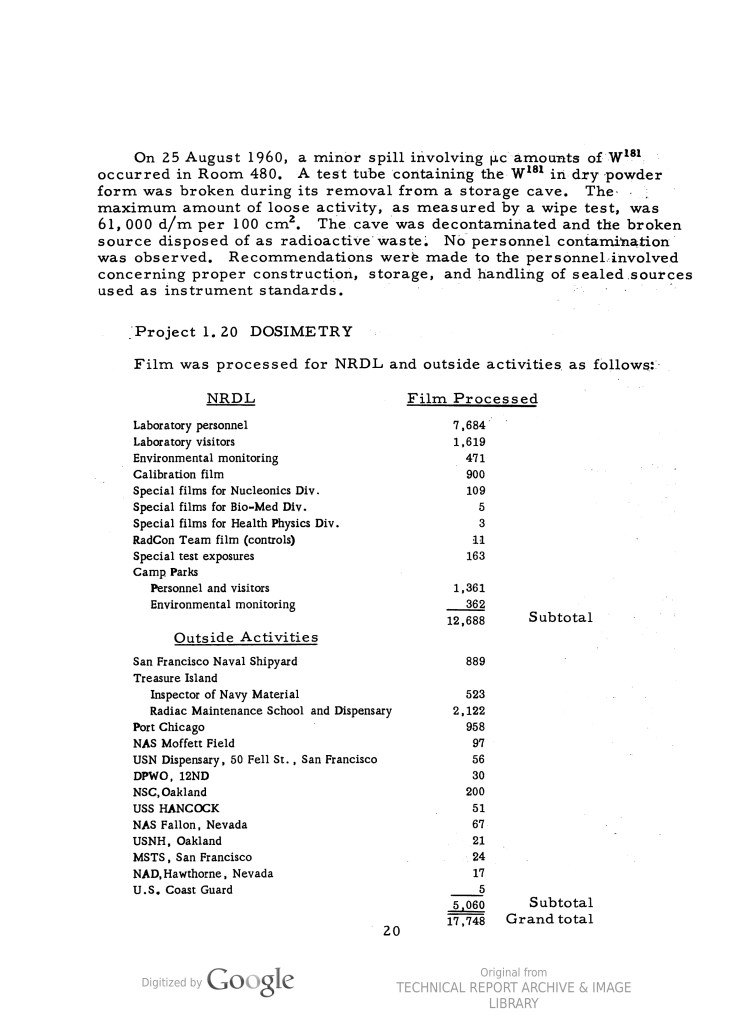
In 1960 the US Naval Radiological Defense Lab developed 2655 Radiation Measuring Film Badges for Treasure Island and 12,688 for the US Naval Radiological Defense Lab at Hunters Point Shipyard along with 889 for Hunters Point Shipyard separate from the Defense Lab. These badges are dosimeters that measure how much radiation a person was exposed to during a period of time and they were collected from all over the Bay Area to be developed and analyzed at the Defense Lab for the year of 1960.

U.S. Naval Radiological Defense Laboratory., Naval Radiological Defense Laboratory. (1961). Radiological safety at USNRDL: annual progress report health physics division ; 1 January to 31 December 1960. San Francisco, California: U.S. Naval Radiological Defense Laboratory. p 20

This document is a who’s who of radiological exposure just for one year at the US Navy’s Radiological Defense Laboratory and I highly recommend it as reading material to give you a look into the radiation experiments they conducted on the shipyard (including building numbers) and all throughout the Bay Area, including downtown San Francisco!
The presence of radiation badges means each time a human being was exposed to radiation over the course of an experiment or regular monitoring of radiation exposure on site. A very frequent and robust radiological contaminations were taking place at the Shipyard and Treasure Island in 1960.

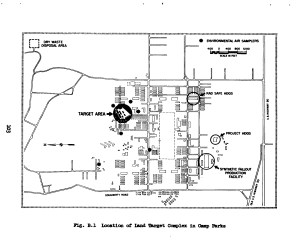
Camp Parks in Dublin CA was the field station for the Lab where they conducted radiological tests on the base while military personnel worked and lived on the base. These experiments included using the gymnasium to rain down radioactive isotopes to determine its effects on roof structures and that gymnasium was then “cleaned up” and was used by the Navy and then the Air Force when they took over the base and as recently as last year by private entities before it was torn down. Stanford Research did a lot of radiological work at Camp Parks and it is clear they had many nuclear accidents reported in this report from 1960.

They did this for other locations listed below:

Dosimeter films developed at the USNRDL 1960
NRDLFilm ProcessedTotals
Laboratory personnel7684
Laboratory visitors1619
Environmental monitoring471
Calibration film900
Special films for Nucleonics Div.109
Special films for Bio-Med Div.5
Special films for Health Physics Div.3
RadCon Team film (controls)11
Special test exposures163
Camp Parks Personnel and visitors1361
Camp Parks Environmental monitoring362
12688Subtotal
Outside Activities
San Francisco Naval Shipyard889
Treasure Island Inspector of Navy Material523
Treasure Island Radiac Maintenance School and Dispensary2122
Port Chicago958
NAS Moffett Field97
USN Dispensary, 50 Fell St. , San Francisco56
DPWO, 12ND30
NSC, Oakland (Naval Supply Center, Oakland)200
USS HANCOCK51
NAS Fallon. Nevada67
USNH, Oakland (US Naval Hospital Oakland)21
MSTS, San Francisco24
NAD, Hawthorne, Nevada17
U. S. Coast Guard5
5060Subtotal
17748Total

The Uptake by Plants of Plutonium and Some Products of Nuclear Fission Adsorbed on Soil Colloids

[Editors note: plants absorb contaminants, so in radiological areas it is important to not landscape them, that by doing so spreads the radition or contaminates into the ecosystemand food chain. Extensive testing in this area was extensively conducted to determine the extent of the contamination. ]

“It has been found that barley and pea plants take up the fission elements Y (yttrium), Ce (cerium), Zr (zirconium) + Cb (columbium), Te (tellurium), Sr (strontium), and the three valence states of Pu (plutonium), even when these elements are present in trace amounts on the surfaces of clay or soil particles. For all the elements tested, the greatest fixation is in or on the roots. With the exception of Sr, translocation occurs only to a limited extent. The trans- location of Sr is relatively quite large. Activity levels of 0.1 microcuries per gram of soil are sufficient to cause very pronounced injury over a three-months period. (Technical Information Pilot, Sc. and Technol. Proj. by Library of Congress for Office of Naval Research, 13 Aug. ’48. Abstract furnished by Atomic Energy Commission of article by L. Jacobson and R. Overstreet)”

Citation: 24 Medical News Letter, Vol. 12, No. 6  Friday, 10 September 1948 p. 24 https://hdl.handle.net/2027/uc1.$b364858?urlappend=%3Bseq=210

1946 Project Crossroads Nuclear Test Film

Here is a summary of the time stamps of this video:

Project Crossroads – Nuclear Test Film (1946)
Courtesy: U.S. Department of Energy

1:50 USS independence next to the Nagato before Test Able
2:20 target ships mapped
4:14 The scientists and samples
6:00 Radio controlled drones
7:00 Manhattan project scientists at Kwajalein
9:40 dropping of the bomb
14:31 diffused cloud “dangerous radioactive particles in the air had become so diffused it was no longer a danger to the area.”
15:52 camera on bikini showing shock wave.
17:20 map of what ships got hit as they dropped the bomb off target. Independence noted
18:55 Independence seen just after explosion when the support ships entered the lagoon.
21:54 animals
24:31 Skate stating the inside were damaged, so they went inside it.
25:21 USS Independence
27:34 Baker Test, second test underwater explosion.
40:00 USS Independence

https://youtu.be/2HkLZekOZLU
Project Crossroads – Nuclear Test Film (1946)
Courtesy: U.S. Department of Energy

Continue reading “1946 Project Crossroads Nuclear Test Film”

USNRDL-TR-256 PROTECTING AND CLEANING HANDS CONTAMINATED BY SYNTHETIC FALLOUT UNDER FIELD CONDITIONS

Purposely contaminating hands to see what damage it would do and to figure out how to protect hands during radiation tests. Also this shows how they lay out radiation tests with the names of the mailing lists. At the time of publication this was secret information so they kept track of who got which report. Note “* number” is the citation number. La140 is Lanthanum 140 a radioactive isotope which is a daughter product of Barium 140 and due to its use this means that at Camp Stoneman had a hot cell on hand to mix the radioactive materials into the sand so workers deposited the radiation using lawn fertilizer spreaders onto roofs, yards and roads in what is now modern day Pittsburg California.

This article is the result of the staff being contaminated by spreading radioactive materials all over buildings, streets and roads of what is present day Pittsburg California and was the second Camp Stoneman radiation test published in 1958. Previous studies had been conducted using more damaging long lasting radiological isotopes and they wanted to make sure that they were cleaning up with sufficient means to protect themselves from the radiation.
Pittsburg California Radiation Experiments covering half of the City

PROTECTING AND CLEANING HANDS CONTAMINATED BY SYNTHETIC FALLOUT UNDER FIELD CONDITIONS Research and Development Technical Report USNRDL-TR-256
NY 320 – 001
U. S. Army
27 August 1958
by
R. H. Black
U. S. NAVAL RADIOLOGICAL DEFENSE LABORATORY San Francisco 24, California

Health and Safety Technical Objective AW-5C – Technical Developments Branch
M. B. Hawkins, Head Chemical Technology Division
E. R. Tompkins, Head Scientific Director Commanding Officer and Director P. C. Tompkins
Captain J. H. McQuilkin, USN
U. S. NAVAL RADIOLOGICAL DEFENSE LABORATORY San Francisco 24, California

ABSTRACT Hands of field test personnel became radioactively con- taminated with (a) dust slurry synthetic fallouts containing La140 tracer, and (b) La140 in acid solution. Two protective creams and several cleaning materials were used in an attempt to reduce adherance of contaminant and to facilitate decontamination. The protective creams were not found to be advantageous. Three experimental cleaning solutions (isotonic neutral solution of a complexing agent plus a detergent and germicide; an isotonic saline solution at pH 2.0 plus detergent and germicide; and a 3% citric acid solution) were found to decontaminate skin more readily than soap and water. A waterless mechanic’s hand cleaner was found to clean hands with the same effectiveness as soap and water.

Continue reading “USNRDL-TR-256 PROTECTING AND CLEANING HANDS CONTAMINATED BY SYNTHETIC FALLOUT UNDER FIELD CONDITIONS”

Lennar HQ at HPS is contaminated with nuclear radiation officials and politicians exposed to cancer causing isotopes

City of San Francisco Officials, City Staff, Politicians and their families, why do you think your are immune to radiation? It is not just for poor people, it is an equal opportunity killer and you were exposed.

Lennar builders couldn’t have picked a worse site to locate their site office at Hunters point Shipyard, the Submarine Barracks, the decontamination chamber for the dock workers who sandblasted the radioactive ships from the Atomic Bomb tests in the Pacific.

If you worked for Lennar, or if you were a city official, or staff for the politicians, or a politician, and their families who did photo ops on the shipyard, you will need to watch out for cancer for the rest of your lives. That means telling your doctor that you were needlessly exposed to the products of an Atomic Bomb:

EPA Facts about Plutonium
EPA Facts About Strontium 90
EPA Facts about Cesium 137
EPA Facts about Cobalt 60 Continue reading “Lennar HQ at HPS is contaminated with nuclear radiation officials and politicians exposed to cancer causing isotopes”

Dublin California Radiation Experiments at Camp Parks


Camp Parks is a Air Force Base that was previously a Navy Base used for radiation experiments in the late 50’s to mid 60’s where they purposely spread radioactive materials onto streets, yards and buildings in order to figure out how to clean up after a nuclear blast. The Navy created dirty bomb incidents all over the Bay Area and trained military personnel from all branches to clean up after a nuclear blast to remove the radiation by scrubbing, firehosing or with street sweepers etc. In the early days, the late 1940’s they thought that fallout was not dangerous, it was not until Operation Castle in 1954 when radioactive fallout fell onto Enewetak Atoll where US military personnel were stationed as well as natives and they got radiation burned from the fallout.

Camp Parks Cobalt 60 Experiments
Camp Parks was used for many radiation experiments Which I will list above when I get the articles up on the site. Fortunately in Complex III tests they decided to limit the amount of radiation they spread onto the grounds, the roads and buildings to .1R per hour which today is a nuclear accident in a nuclear power plant.

Later it would dawn on the Navy that they could use a d
ifferent colored sand and then just count the grains to figure out the amount of fallout. Continue reading “Dublin California Radiation Experiments at Camp Parks”

Treasure Island California Site

I am posting more Treasure Island sources on this site as the amount of content would fill up my Disaster Area site. So for the time being, search this site and the Treasure Island California Site for content on Treasure Island. It is quite extensive.

https://treasureislandcalifornia.wordpress.com/

Treasure Island – Biological and Chemical Training on USS Pandemonium Dec 1956 Naval Training Bulletin

USS Pandemonium being built for Biological, Chemical training. Naval Training Bulletin December 1956 pp 9-11. HathiTrust Link
Note the students training:
Page 10: July 1955 – – Students practice Biological and chemical warfare countermeasures on deckhouse.
PAGE 10: Lower right Construction work is suspended temporarily for class drills.
pAGE 11: September 1956 – – A class hoses down the main deck aft. The 40 mm and K guns have just been acquired.

Naval Training Bulletin December 1956, pg. 9

1946-09-23 REPORT NO. 8 – EXPERIMENTAL WORK AT SAN FRANCISCO NAVAL SHIPYARD

Citation: OPERATION CROSSROADS, RADIOLOGICAL DECONTAMINATION OF TARGET AND NON- TARGET VESSELS Part 2 pp. 48-55

REPORT NO. 8 – EXPERIMENTAL WORK AT SAN FRANCISCO NAVAL SHIPYARD
Work on Monday, 23 September 1946:

USS BENEVOLENCE: Setting up of an acid mixing tank on the main deck ana the hookup Of the evaporators so that all six effects will be completely filled with circulating acid was accomplished during the day. The tank was set up on the main deck to simplify operations and keep the evaporator room from getting cluttered up with acid barrels, etc. Where the Yard felt it necessary, sections of piping removed from the evaporators were kept and new pipes substituted. “Hot*’ valves were dipped in a two normal solution of Hydrochloric Acid on the main deck. The valves showed some radioactivity after ten to twenty minutes of such treatment but were declared safe for work by X31 provided there was sufficient ventilation for anyone working on them. Continue reading “1946-09-23 REPORT NO. 8 – EXPERIMENTAL WORK AT SAN FRANCISCO NAVAL SHIPYARD”

1946-09-21 REPORT NO. 7 – EXPERIMENTAL WORK, SAN FRANCISCO NAVAL SHIPYARD

Citation: OPERATION CROSSROADS, RADIOLOGICAL DECONTAMINATION OF TARGET AND NON- TARGET VESSELS Part 2 pp. 42-47

REPORT NO. 7 – EXPERIMENTAL WORK, SAN FRANCISCO NAVAL SHIPYARD
21 September 1946

Friday, 20 September 1946:

At a meeting of Ship Superintendents, Lt. Comdr. Turnbaugh outlined the experimental work yet to be dope aboard the Bikini vessels. The work by ships

(1) USS BENEVOLENCE
(a) Completion of Acid experiment on Evaporators
(b) Flushing salt water system with fresh water.
(c) Washing floor plates and bilges in condenser room with ammonium citrate. Continue reading “1946-09-21 REPORT NO. 7 – EXPERIMENTAL WORK, SAN FRANCISCO NAVAL SHIPYARD”